

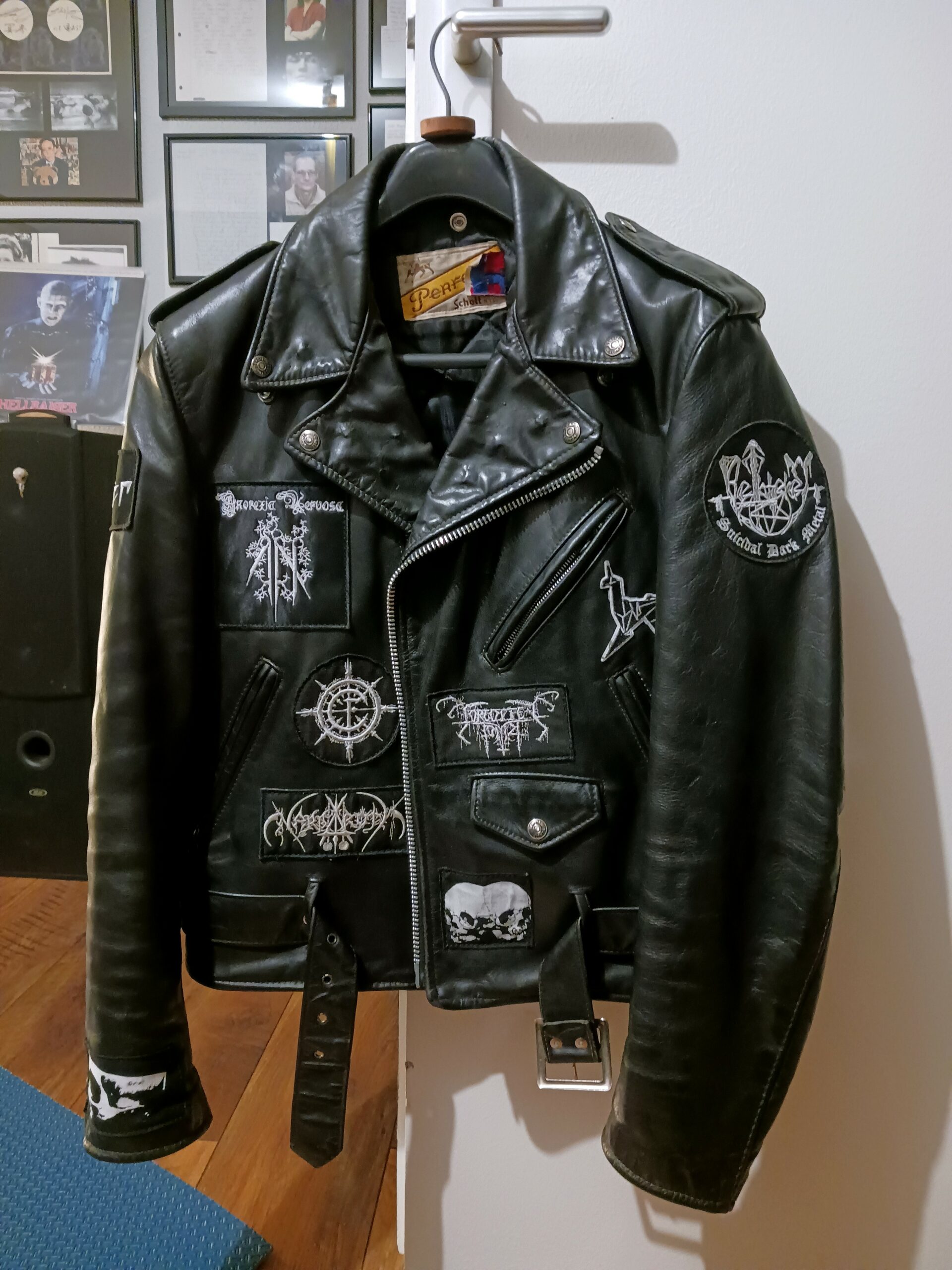
Mainly focused on the grunge that was playing on the radio, my interest quickly shifted toward black metal, which became my favorite musical genre. I always contented myself with wearing T-shirts, but I felt that something had been missing for a long time: the Battle Jacket! So, once I passed forty, I told myself it was now or never. I finally took the plunge with a composition of patches collected over the years, some bought new and others second-hand, already endowed with their own mysterious aura and personal history, which I wanted to bring back to life by adding my own story.
Every battle jacket must be unique, like human skin covered with tattoos reflecting one’s life, experiences, and thoughts.
But now, let’s get to the heart of the matter: my jacket, my project. I know that negativeproduction.com is not meant to drift away from its main themes, but I think this is a good place to share this, and it also tells a bit about who I am.
MY BATTLE JACKET
The base is a SCHOTT perfecto jacket (the real American perfecto!) from the 1990s, made of thick bull leather, made in the USA, and bought second-hand on eBay about ten years ago. The jacket already has its own history. For the record, it was originally a gift from a man to his wife, but it was too big for her and it was a men’s cut. Eventually, it ended up for sale on eBay, and I immediately fell for it.
I spent a long time thinking about the theme and composition of my ideal battle jacket. Long before taking the plunge, it was already clearly designed in my mind. I conceived it around bands from the second wave of black metal, from the late ’90s to the 2000s. Because this is the period I love, that speaks to me, and above all, it is mine—the time of my youth, now that I am over forty. In my opinion, it was also a more authentic, more radical, and far less consensual period than today. It suits me well, because in general, I do not compromise. Contemporary black metal, whether it likes it or not, owes everything to those extreme bands that today are largely sacrificed on the altar of modern morality.
It is necessary to recall that, originally, black metal is rooted in a radical rejection of dominant norms—mass society, conformism, religious values, and modern materialism—and is nourished by an attraction to dark spirituality and paganism, a misanthropic individualism imbued with black romanticism, a mystical relationship with nature, and an aesthetic founded on transgression.
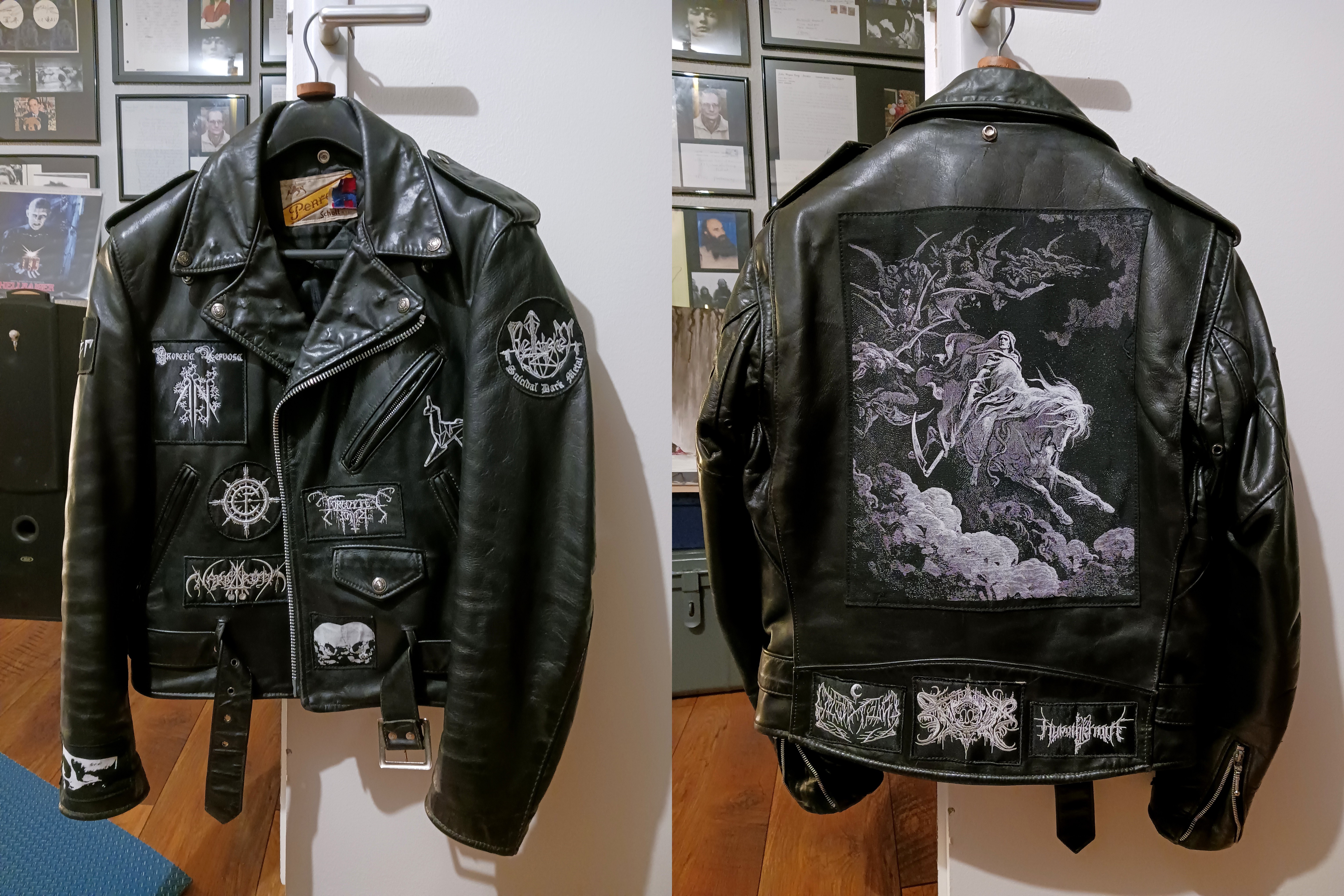
The main theme of my jacket is therefore depressive black metal. It features patches from bands such as Silencer (Sweden), cult for its deranged high-pitched vocals and the sordid legends surrounding its singer Nattramn, Bethlehem (Germany), Leviathan (USA), and Xasthur (USA). There are also some variations with Hypothermia (Sweden), which leans toward black ambient/post-rock but also played depressive black metal in its early days, Carpathian Forest (Norway) for its darkness and morbidity, Forgotten Tomb (Italy) for its spatial atmospheres, and Nargaroth (Germany) for its folklore.
On the chest, I placed a patch of Anorexia Nervosa (France), a symphonic black metal band and a flagship of the French black metal scene of the 2000s, with its romantic-nihilistic style, its blast beats, and the unique voice of the intense Rose Hreidmarr—whom people either love or hate. I have never seen anyone take a middle position when talking about him. Opinions are often very polarized, influenced by factors other than the music itself, which I find unfortunate and rather pointless. It is one of my favorite bands, it always will be, and I will always listen to it
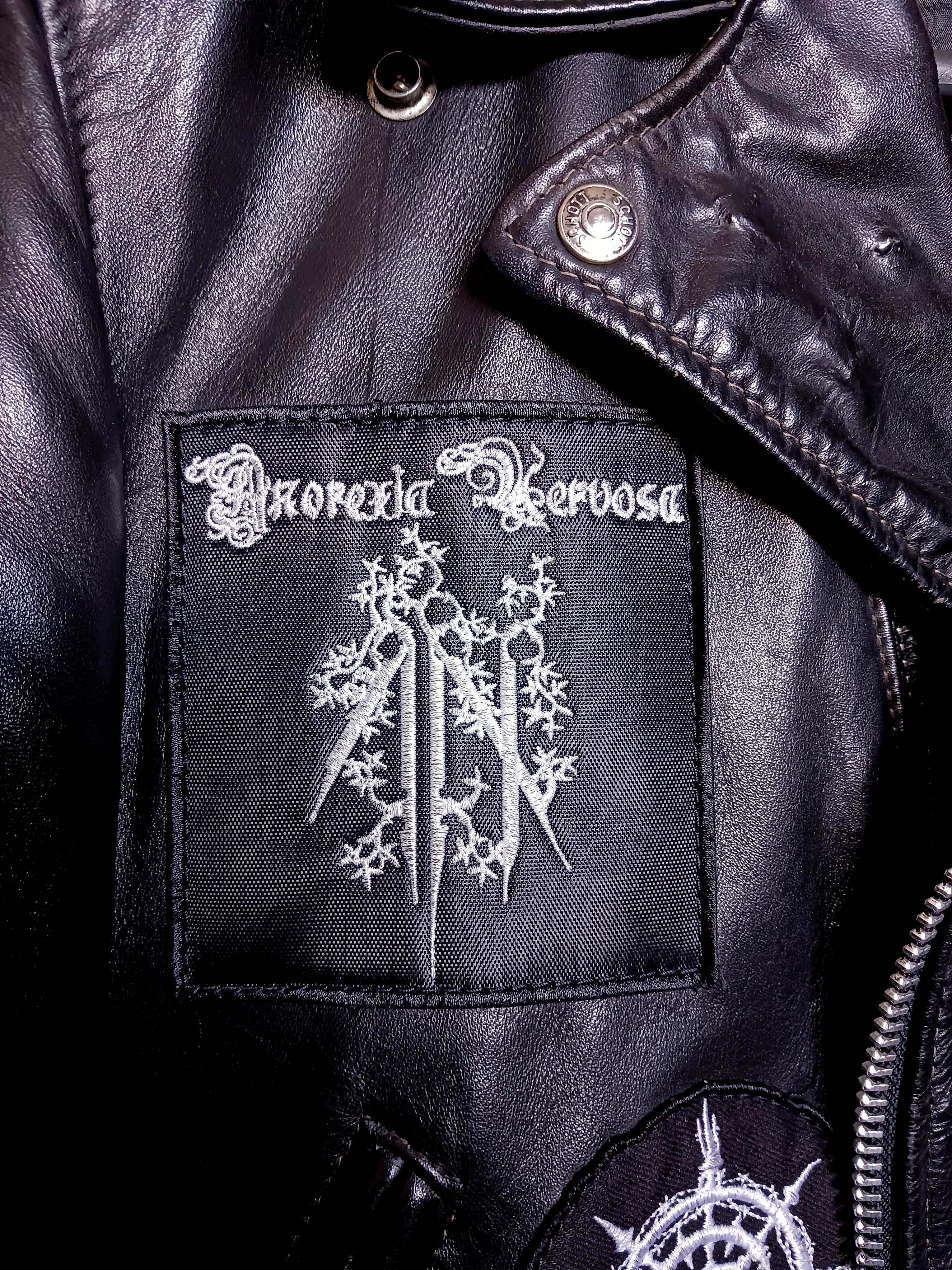
Anorexia Nervosa was, and will remain, one of the best bands in the French black metal scene. Their work is original and highly qualitative, both in terms of composition and lyrics in French and English, with very nihilistic themes describing human decadence in all its neurosis and madness. Musically, there are classical influences, ranging from Bach to Wagner, which, on a mental level, when listening to Anorexia Nervosa, transports you to a hysterical and decadent late 18th century and a dark, violent early 19th century. Personally, it reminds me of historical periods such as the Reign of Terror during the French Revolution, a subject I have read a lot about.
On this website, there is this very fine review (in French):
Anorexia Nervosa – Sentiment: A Little-Known Black Pearl of Symphonic Black Metal
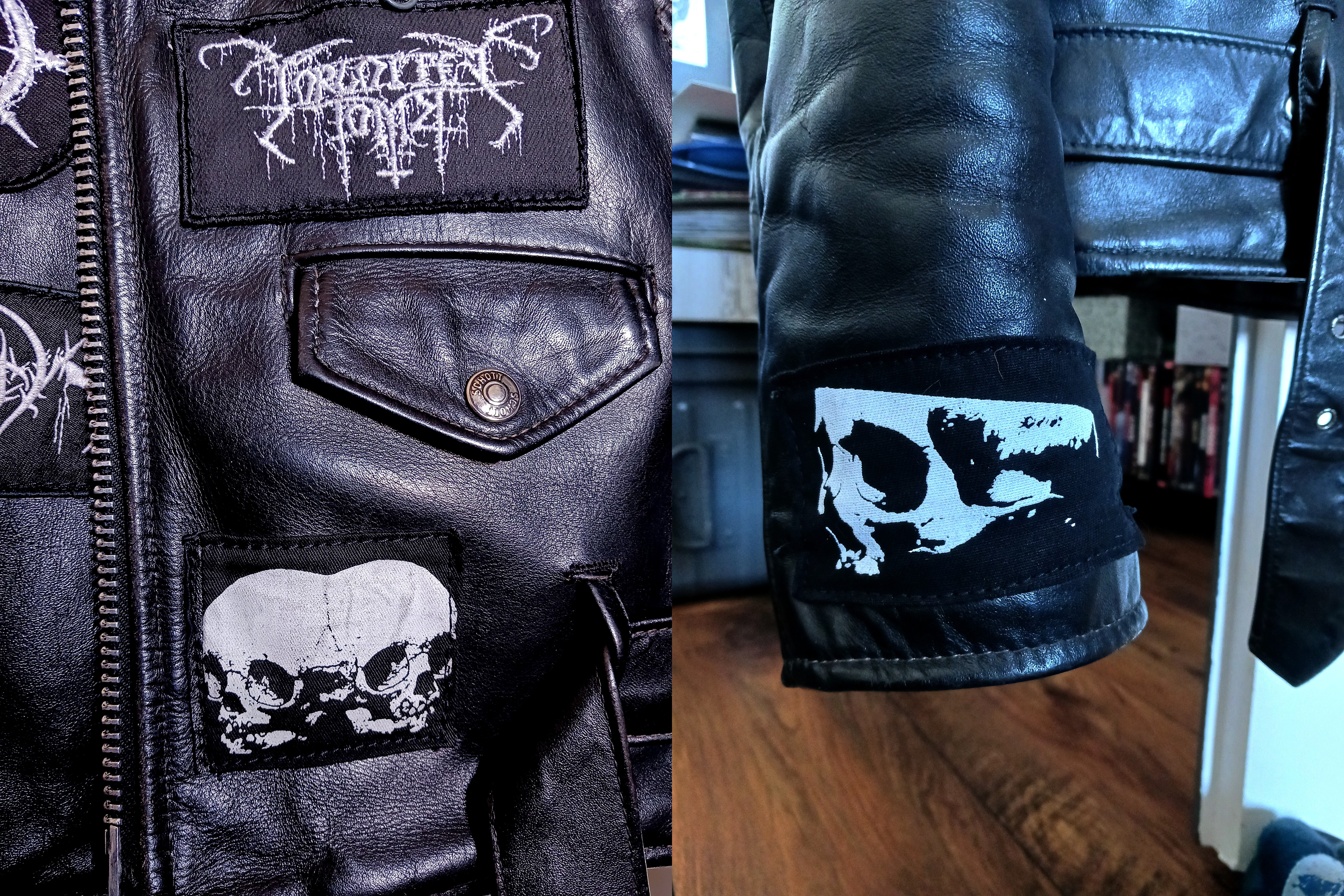
On my battle jacket, I also wanted to add a graphic touch by placing two patches representing skulls. One is a medical dissection skull (at the bottom of the right sleeve), without the mandible or cranial vault, and the other is a teratological fetal skull of conjoined craniopagus twins, joined at the head (lower front/left side, between the zipper and the belt). This provides a visual focus on Death and nothingness, of course, but also evokes the finitude of humankind and its random existential dimension within biological evolution, subject, like all beings, to biological fate and genetic accidents. No matter how much we dress ourselves in technological finery, we remain flesh and bones.
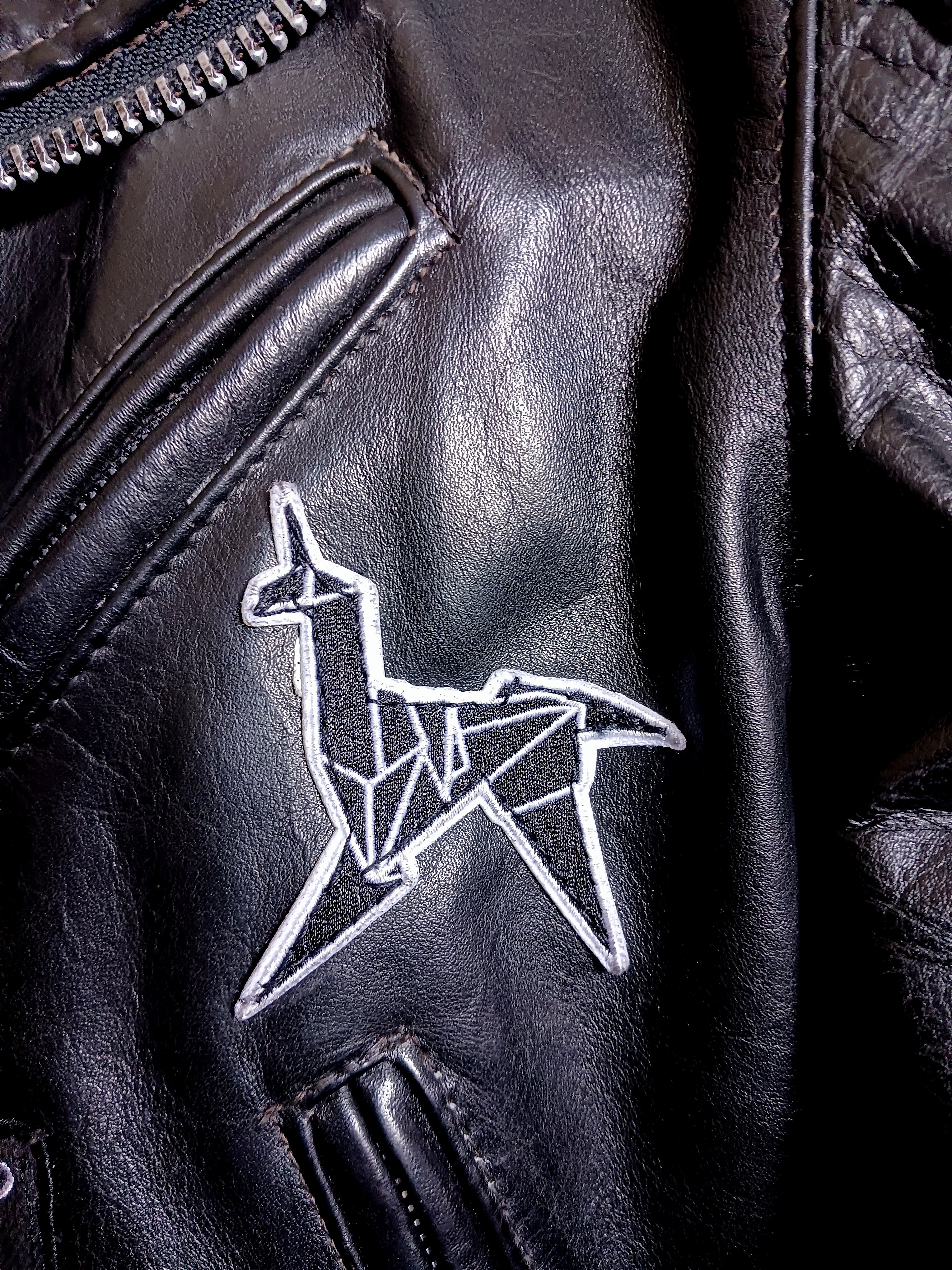
You may have noticed: on my battle jacket, only one patch does not fit within the black metal theme. It is the papier-mâché unicorn from Blade Runner. This choice is not insignificant. The cyberpunk universe portrays a technologically advanced humanity, yet trapped in a cold logic dominated by multinational corporations guided solely by profit. This organization of the world produces a form of dehumanization and a profound loss of meaning. From this situation arise melancholy, despair, nihilism, and a kind of moral depression, all characteristic of cyberpunk. The human being—its sensitivity, depth, and beauty—often fades away there, or survives only through a fragile form of sublimation. In response, cyberpunk develops an aesthetic marked by violence, excess, energy, and creativity, as so many attempts at resistance. It also carries a spiritual, philosophical, and existential reflection.
It is precisely on this ground that the philosophy of black metal meets it, as black metal likewise expresses a rejection of the modern world, a fascination with despair, and a search for meaning in a universe perceived as empty and corrupt.
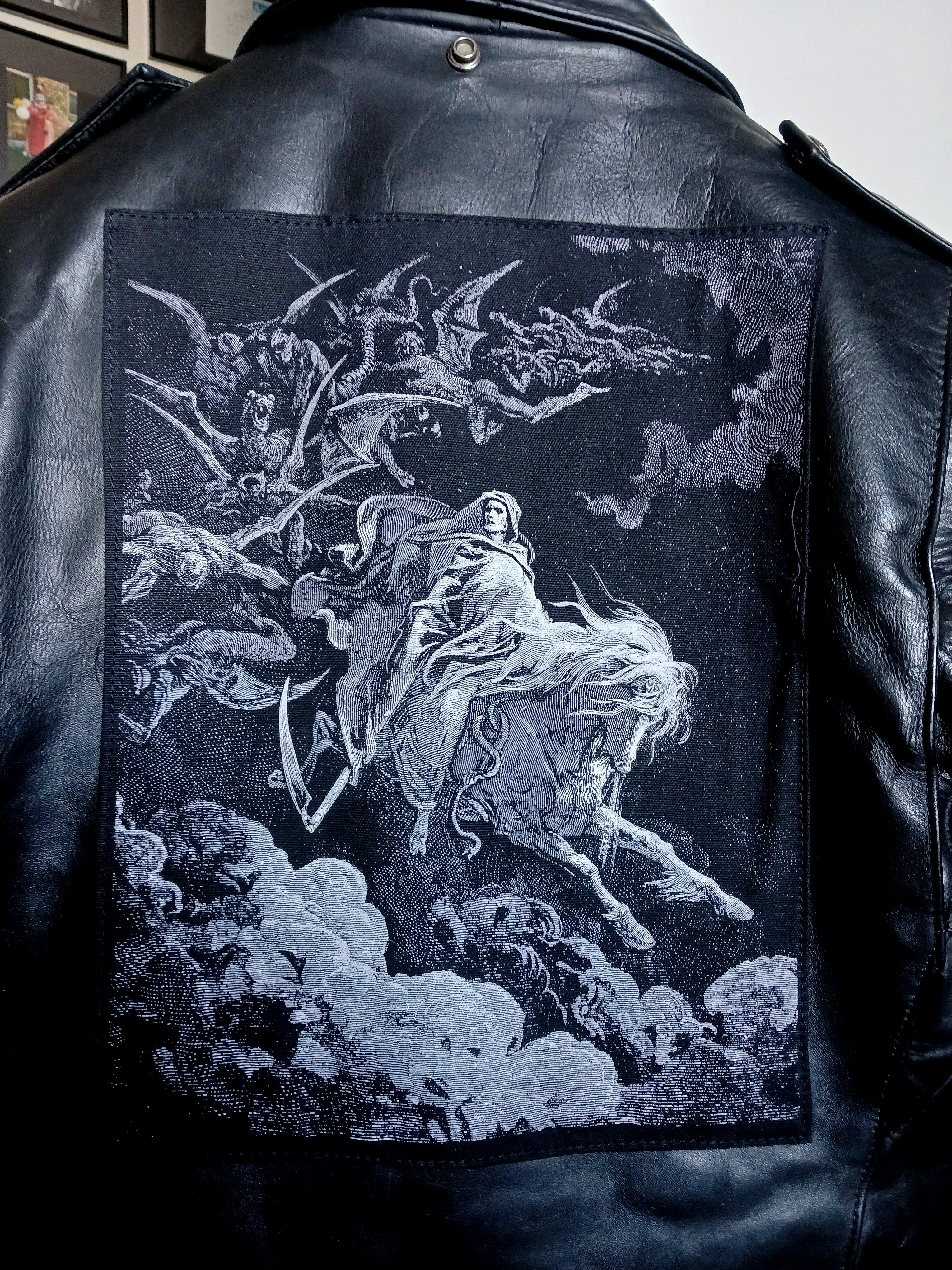
Finally, regarding the large back patch, I did not want it to be that of a band dominating all the others. I do not have just one favorite band, but several. So I subtly chose The Vision of Death by the dear Gustave Doré (1832–1883). It remains within a romantic and symbolic 19th-century vision, yet it is also very timeless. However, it should be noted that this engraving was used by the band Emperor (Norway) for their first demo album, Wrath of the Tyrant. Using this artwork establishes a connection without making the back patch an official Emperor centerpiece (which I also love!). I wanted to preserve neutrality for the back patch and simply have a beautiful visual that matched the theme of my battle jacket.
After all, they say that a work of art is never truly finished, only abandoned. Who knows—maybe it will be expanded again in the future… History is not set in stone.